Thursday, December 16, 2010

Barrister Passes on


Barrister Dead

Sikiru Ayinde Barrister, Nigerian Fuji music legend, passed on, December 16, Saint Mary Hospital, Paddington, United Kingdom.
Born on 1942, Barrister, started his life under rough financial circumstances. He attended a Qurannic school and later Yaba College of Technology but later dropped out of the college because he could not afford the tuition fees. He went to train under a stenographer and later volunteered as a soldier in the Nigerian Army during the civil war of 1967 and 1970.

Meanwhile, Barrister had developed an interest in music at the age of ten, and had mastered a music style that was traditional used during the month of Ramadan. Signed to Africa Songs Ltd, a Nigerian record label, Fuji Garbage, as he was famously known, produced many songs alongside the Supreme Commanders, a 25 man band, that not only carried moral and religious depths but were financially groundbreaking. He later worked with the African Musical International, a smaller music group.


Fuji Garbage, as he was famously called, also experimented with Apala, Juju and other older Yoruba music forms, which he introduced with enigmatic use of percussions. He was also a musical genius who used his voice to convey the pulse of the people in many national issues while some of his songs re-enacted some of the experiences of the people. Some of the albums produced by Sikiru Ayinde were Ejeka Gbo T’Oloun in the late 1960s, Alayinde Ma De O, Itan Anobi Rasaq, Ori Mi Ewo Ninse, late 1970s, and Aiye Dun Pupo/Love In Tokyo, 1975.


He also produced popular albums, Fuji Exponent, 1976, Omo Nigeria, 1977, London Specials, 1978, and Iwa, 1982, among others. His fuji movement has grown with young fuji musicians like Osupa Saidi, Pasuma and others.

Barrister Passes on


Barrister Dead

Sikiru Ayinde Barrister, Nigerian Fuji music legend, passed on, December 16, Saint Mary Hospital, Paddington, United Kingdom.
Born on 1942, Barrister, started his life under rough financial circumstances. He attended a Qurannic school and later Yaba College of Technology but later dropped out of the college because he could not afford the tuition fees. He went to train under a stenographer and later volunteered as a soldier in the Nigerian Army during the civil war of 1967 and 1970.

Meanwhile, Barrister had developed an interest in music at the age of ten, and had mastered a music style that was traditional used during the month of Ramadan. Signed to Africa Songs Ltd, a Nigerian record label, Fuji Garbage, as he was famously known, produced many songs alongside the Supreme Commanders, a 25 man band, that not only carried moral and religious depths but were financially groundbreaking. He later worked with the African Musical International, a smaller music group.


Fuji Garbage, as he was famously called, also experimented with Apala, Juju and other older Yoruba music forms, which he introduced with enigmatic use of percussions. He was also a musical genius who used his voice to convey the pulse of the people in many national issues while some of his songs re-enacted some of the experiences of the people. Some of the albums produced by Sikiru Ayinde were Ejeka Gbo T’Oloun in the late 1960s, Alayinde Ma De O, Itan Anobi Rasaq, Ori Mi Ewo Ninse, late 1970s, and Aiye Dun Pupo/Love In Tokyo, 1975.


He also produced popular albums, Fuji Exponent, 1976, Omo Nigeria, 1977, London Specials, 1978, and Iwa, 1982, among others. His fuji movement has grown with young fuji musicians like Osupa Saidi, Pasuma and others.

Coca-Cola Lights Up the Moment


In the spirit of the yuletide Coca-Cola Nigeria, one of Nigeria’s beverage brands, ushered in the festive season with its annual Coca-Cola Christmas Tree Lighting Ceremony, December 10, at the National Theatre, Iganmu, Lagos. The place was filled with both A-class business personalities and youths who came with different shades of red as dress code to savour the moment.

Signalling the festive period was the presence of the landmark 33.5 meters tall Christmas tree which have been regarded as the tallest in Africa. The Christmas tree, fondly “Red Coke Tree” weighed 15 tons and was placed on a 2.5 meters high platform, it would remain at the location for 30 days. A myriad of Individuals who attended the event described it as “It was a spectacle of sparks, music and merriment”.

Micheal Ufomba, Marketing Director of Coca Cola Nigeria told pressmen that the tree lighting ceremony began in 2007 and has being widely embraced by Nigerians. Ufomba noted that the event foregrounds the company’s commitment in unifying families during the festive season. “As the Universal beacon of Happiness, Coca-Cola, more than any other brands, embodies the essence of the festive season-Joy, love and sharing. Coca-Cola is synonymous with celebration and a toast to open expression of love”, He added.


Unlike in previous years where the tree lighting ceremony was performed by dignitaries, this year’s ceremony was meant to honour Sharon Douglas, one of its major distributors who started small but had grown to colossal heights in marketing. Douglas, who declared the tree lighted, acknowledged the tremendous support she had enjoyed from Coca-Cola Nigeria and Nigerian Bottling Company in growing her business. “I am truly blessed to be here today at this remarkable event and I thank Coca-Cola for being true to their word and upholding me till this day”, she added.

Clem Ugorji, the company’s Communications Manager attested to her story of perseverance. Ugorji recalled that Douglas ventured into business as an unemployed graduate with one crate in 2004 but today sells 12, 000 crates monthly. For him, she represents all the companies’ distributors who are key partners to the business. Coca-Cola is capable of providing a new lease of life in areas of economic employment especially for women who constitute over 60 per cent of its distributorship across the country, He noted.

Coca-Cola Nigeria Limited is a subsidiary of The Coca-Cola Company. The company produces Eva water, Diet Coke, Fanta, Sprite and Cappy Fruit Juice. Coca-Cola Nigeria Limited and its bottling partner, Nigerian Bottling Company Plc, represents one of the country’s largest private sector employers with about 6000 direct employees and more than one million others indirectly employed in its vast network of distributors and retailers nationwide.

Tuesday, November 30, 2010

Beautiful Nubia and the enthronement of musical Performance


Beautiful Nubia thrilling the crowd who left their seats...)

(All pictures were taken by Lolade Adewuyi of lagoscityphotos.blogspot.com-He is one of the finest and dynamic photojournalist I have met).

All roads led to Ile-Ife and Oshogbo, Osun State for the Eniobanke Music Festival, EMUFest, a musical tour with the purpose of bringing alive folklore, performing arts and African consciousness, 28 and 29th of November at the Amphitheatre, Obafemi Awolowo University, Ile-Ife and at the Delightsome Hotels and Resorts, Oshogbo.

It was no doubt a funfare filled with felicity and musical fecundity as it featured acts like Orlando Julius, Jimi Solanke, Beautiful Nubia and Yinka Davies. The day which coincided with the swearing-in ceremony of Rauf Aregbesola, the new Osun State governor, a pedestal Aregbesola got after rigorous legal battles, further magnified the joy in the people hearts, in the state.

For Nigerians, there was no better escape from the strain of modern rigours meanwhile for students of OAU, it was a time to close the chapters briefly and relax
as the examinations stare into their faces.

Although the events started a little late at Ife, the amphitheatre was soon full to the nostalgic feeling of the oldies. Songs like Columbia, Asiko lo laiye Adara, by Orlando Julius and His AfroSanders, one of Nigeria’s highlife icons, with ecstatic dance steps from his female dancers, it was not only a festival it was a musical of the greats, as Orlando thrilled the students with incandescent thrill and expert combination of musical instruments. For almost everyone, they were reliving childhood memories and rekoning with the need for Africans to be united.

Talk of reliving childhood memories, Jimi Solanke, was the champion of children folklore and had remained so since the 1960s when he started his musical experience with the late IK Dairo. With all sense of simplicity and with his usual tale bearing swagger, Solanke brought the crowd into another session of dancing steps, with unforgettable folkore from almost all the ethnic groups in the country.


(Professor Oxford, far from the maddening)

In fact, the audience travelled as far as Jamaica from Story land to Ibadan to Onilegogoro as Solanke danced like a young man in his twenties. Solanke’s funny and sensual innuendos, songs and limericks have not left him either, people were no doubt comfortable with that part of our culture that entertains in sensual codes-so there was no cause for alarm. Solanke also raised socio-political issues with his song titled By the year 2000, as he sang about the eternal postponement of basic amenities and Teacher, a song about the importance of teachers in society.


( Jimi Solanke, King of African Folklore)

Yinka Davies, award winning singer, was the dame of the night as she humbled herself in doing several duets with Orlando Julius, her dance steps where no doubt like a mermaid in her natural habitat. Beautiful Nubia, reknowned performance poet and dredlocked musician, came into the stage with uproar and a standing ovation from the crowd. Songs from his albums, Jagbalanjubu, Irinajo and a host of others were sung by him and Roots Renaissance Band, his band.
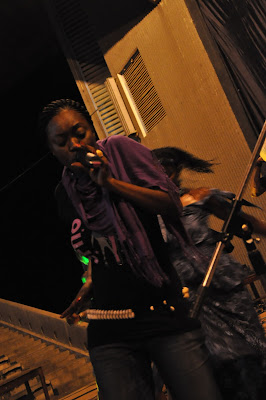

(Yinka Davies with her enchanting swagger)

However, this serenity of soul was interrupted by students of the Awolowo Hall, famously called Awo Boys (for their creative eccentricity), who decided to disrupt the programme if Beautiful Nubia did not prostrate for them. This demand made by students of Awolowo Hall was stated as customary for any musical star that performed in the University.

However, Beautiful Nubia refused to prostrate because he felt in the Yoruba hierarchy the elderly do not prostrate for the people of younger ages. For Nubia, “it is only those who do not know their roots that abide by such laws”.
This statement brought the festival to a standstill as there was an exchange of words between other students and students of the hall.

Until the timely intervention of Fredrick Joel,FJ, President of the Students Union and other members of the Union who reminded them of Nubia’s contributions in the past. “You will recall that when the union was proscribed in 2006, it was beautiful Nubia who took it upon himself to do a show for the students to help raise money for the union” FJ pleaded with Awo boys. In response Nubia apologised to the students stating that “we have invested so much to come to this great school to perform some of us have not slept for the past five days-anything I may have said that may have angered you. I am deeply sorry”. After all tensions had seized, another round of celebrations began.


(Orlando Julius, Icon of Hilife)

The dredlocked Afrocentric artiste mounted the stage again, this time totally adorned by the regalia of regard by Ife students. At the end of the show, he was lifted up as a sign of respect. The event at ife came to a close with a song in remembrance of Obafemi Awolowo, one of Nigeria’s indefatigable political icons. Speaking to Yemisi Akingbola, a campus journalist, she stated that “Awo boys were not like this in the past-I am embarrassed, a lot of Alumnus, Press men, were around and they behaved without any sense of caution”.

Yinka Davies also complained profusely to the magazine that some students disrespected her as she was trying to placate them, “OAU used to be a dream school but now, I don’t know what to call it any longer-I am not impressed, and if you journalists don’t write about this, then you will be encouraging such barbaric behaviour”. Aspiring performance artiste like Edaoto and Femi were at the event.


(Beautiful Nubia summoned by the the drums)

A delightsome resort, Oshogbo, a haven for lovers of serenity was the next stop. It was as if all strengths were renewed as the people of Oshogbo and visitors danced all the way to the morning. Edaoto and Yinka Davis had separate duets with Orlando Julius. The artistes also had the opportunity to interact with the musicians as they exuded a high sense of simplicity and commitment to youths. For Nubia , “It is not time for the youths to listen to stupid songs but to steady their minds to the voice of change, let us join our hands together to bring change to this country”.

Ekejuba Innocent, student and performance poet agrees with Nubia, “Africa used to be the citadel of leaning and civilisation, the first University was in Timbuktu, but all that has changed, we are now foot mats and mere markets for foreigners-our leaders are also not helping us. We need to form alliances and change the situation of this country-Africa will change if Nigeria changes”.

Friday, November 26, 2010

A Writer’s Dilemma: For the Life of me!


I have been contacted by Cederwood Productions, a publisher that had taken up Silent Drummings, my first collection of poetry, to co-author a collection of poems with Tokunbo Dada. Tokunbo Dada had published his first book with Cedarwood and with many research books roiling in his head every second. He had published a book on child abuse in Africa and the side effects using the story of Shaka the Zulu as a formidable example and the publisher, then based in Osun State was impressed.
Now, Tokunbo had moved higher with a bigger purpose, he had produced Ufiala, a radio drama on the problems of Nigeria and had gone to co-produce other ones depite the fact that he had been employed as a communication enginner at the Federal Radio Corporation of Nigeria, FRCN.

As for me, I am just an unrepentant poet and journalist that I had been and that I had retained except that I just bagged the prestigious Megaphone News Agency’s Award for Meritorious Service to the press, with Silent Drummings doing fairly well. Poetry had never successfully fed anyone in Nigeria, so let me not boast too much.

Cedarwood has opened its new headquarters in Ibadan, the traditional publishing hub in Nigeria, that was a deliverance of some sorts, When I got wind of the romantic collection, I was supposed to co-author, I began to wonder, with who?

Tokunbo Dada had grown to be a bosom friend of mine, a more mature and unselfish friend that had this creative fire, one I respected. I had written a couple of monologues in his room using his directions of how a drama should look like, we had joked a lot about women and we had also learnt a lot from our disappointments. He had told the publisher about the idea and it was bought.

The problem was that I had left the idea of writing love poems since 2005 and I had gone from the simple romantic poet to a thorough-going modernist. I had evolved a personal style after reading TS Elliot, Segun Adekoya, Dogga Tollar, Franz Kafka, Ernest Hemingway and Robert Frost.


Love had not been fair to me. Apart from the fact that I had had a rough upbringing as a third child, I also had a backlash of shattered and interrupted relationships. In fact, my recent girlfriend recently called off what seem to be a compassionate union. So I had begun to retrace my steps in writing love poems, stopped listening to love songs, stopped flirting, totally shut down. It was gradually. In fact I had been mulling on destroying the ones I wrote when the going was going-I don’t know whether it’s good or bad-That was when the call from my publisher came.

Another problem was that my job as a journalist seems to only allow you to think of the next story, the ongoing story or the deadlines-there is hardly any time to write two lines of poetry. The only blessing it offers is that it exposes you to the realities and hypocrisies that make up the society, through printable and unprintable discourses.

So I took my old poems out-my fiery and passionate old poems that I had purposefully dumped at the deep ends of my home’s warehouse. A look at them-they were whack, for God’s sake, I had grown up, I had grown out of it. I am now officially in a dilemma. Can I succumb this dilemma? Will I survive?

I think so, the book must go on, for the life of me, my life is poetry!

Friday, November 19, 2010

Achebe, A month and a Writer


I am happy to tell you that I share a birthday month with one of Nigeria’s greatest writers . This does not however mean that my destiny as one of Nigeria’s youngest poets is sealed, it only means that if Achebe can make a mark as a writer, I too can.

Chinua Achebe, one of West Africa’s award winning novelists, turned 80, November 16. Born in Ogidi, Anambra State, Achebe who is known for his novels, Things Fall Apart (1958), No Longer at Ease (1960) and Arrow of God (1964), studied at the University College Ibadan, now University of Ibadan. He is a recipient of the Order of the Federal Republic, 1979 and the National Productivity Award, 1999. He was listed for the Commander of the Federal Republic in 2004 but rejected it as a protest against the lack of infrastructures in the country. Achebe is also the author of the novels, A Man of the People (1966) and Anthills of the Savannah (1987), amongst a long list of Short Stories, Children Stories, Poetry Collections and Essays. He is the current winner of the Gish Prize, an award for extraordinary impact in their field.

Saturday, November 13, 2010

Nigeria and the Church

I had just gotten from an event.One of the events I particularly have reservations for are a religious events, because you begin to wonder whether you are in a church service on a Saturday. Perhaps, you begin to wonder if you have converted yourself from the sunday pentecostal churches to the Seven Days Adventist or the Jehovah Witness. I had attended some of these events but today's event was different.

It was an Annual Anniversary Lecture of Providence Baptist Church, Dopemu Lagos titled The Church and the Problem of Political Mandate in Nigeria at Lagos Airport Hotel, Ikeja, Lagos, on Saturday 13th November 2010. It was the fourth lecture series that had positioned and posited the Nigerian Christian Community on their roles in Politics and Democratic governance. Professor Yessufu Obaje of the Nigerian Baptist Seminary, Ogbomoso, Oyo State, Nigeria and the erstwhile Presidential Adviser on Christian Religious Matters to President Olusegun Obasanjo, (now former President)presented a paper which was originally titled "2011 Election: You and God" was readjusted to the latter topic. President at the occasion were Anointed Men of God from the Baptist Church, Nigerian Convention such as Reverend Bolaji Oduola, Pastor-in-Charge, Providence Baptist Church and his wife, Grace, Rev. Dr Ademola Ishola, General Secretary, Nigerian Baptist Convention, ably represented by Rev.GA Awotunde, General Secretary of Conference, Lagos East Rev. Dr SAA Olaide, Rev J Aremu,Confernce Chairman, Lagos West, Adeniyi Adeniji, Conference Secretary Lagos West.

I and a good friend Abraham Oladipopu of the guardian newspaper were there to cover the event.

Now straight to the words that made the event worth it and better than other religious events. Lest I forget, Obaje is a professor of Systematic Theology and Philosophy, the President of Peace on Earth Mission and the former president of the Baptist Convention. He is a completely intellectual, philosophical and spiritual personality. A situation largely missing in the Nigerian Christian Commmunity. Obaje was also the Former Chancellor, Bowen University, Iwo, Ogun State and Former Chaplain, State House, Federal Republic of Nigeria. He has also contested for the post of Niger State Governor which he lost. According to him, he lost because he was not ready to bribe his way into the Niger State house.


Read these words if its difficult to read the above

On the National Assembly
There is a need to sanitise the national assembly. These are one of the national evils. lawmakers are not supposed to lawless but these ones are ready to breach the constitution " after all we are the lawmakers
.

On Politics
Politics is not a dirty game but 90% of Nigerians who say they are politicians are satan-centered politicians

God is a politician, whether we like it or not. Its about God's authority over creation
(note, I used to say this at the University back then and people used to hate me for it, now a priest turned politician is saying it again.

On Politicians
They Steal and Steal until they steal their own souls out of heaven

Let us have a law for people who steal our money (as a nation, in corporate world), all your titles would be dropped and any occasion they go they should introduce them as Thief this, thief that for ten years


On Nigerian Education
honourary degrees are given so that they (the awardees)can give them money.Even those who can hardly spell their names


On the Church
We need to act and pray, else we would have trouble on our hands

The church must come to terms to the reality of its role in politics, else it will lose its relevance. Politics is the mission of the church.

It is now our responsibility to rewrite of our theological history

On Nation building
There are three national cancers that needs to be attended to in Nigeria, Wickedness, Ignorance and Poverty.


On Nigerian People
The phrase, Good people, I respect Honourable Minister, Dora Akinyuli but I cannot accept it. How many Nigerians can spend their children to the village. You are afraid of the good people who are there

The highest level of dehumanisation is for people to control your conscience

Christians are uncommitted spectators in politics


On Free and Fair Elections
Nobody should expect free, just and fair election. Ignorance is pivotal to the problem of Nigerian elections